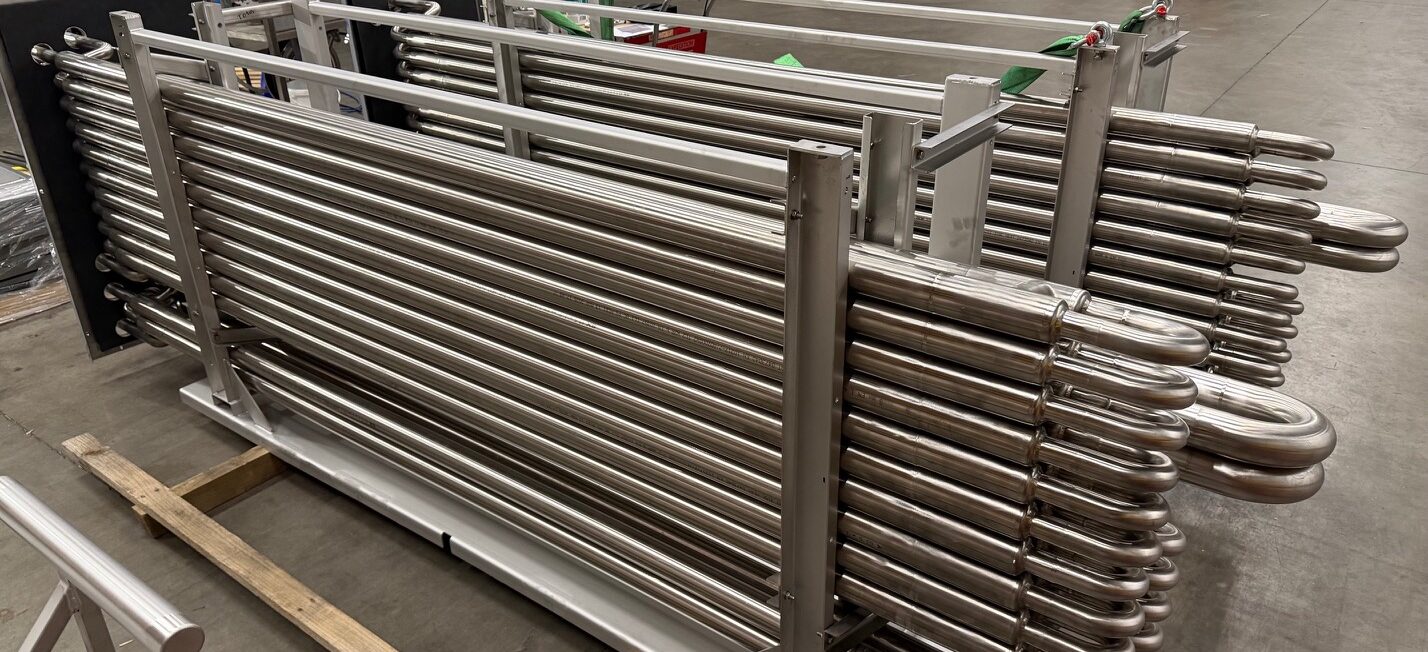
Échangeur thermique Actini Group

Industrial heat recovery for thermal processing

Making better use of process heat

Thermal processes often involve both heating and cooling stages. As a treated product or liquid effluent cools, some of its thermal energy may still be available for reuse.

Where operating conditions allow, this heat can be recovered and transferred to incoming process fluids, reducing the additional energy needed to bring them to the required temperature.

Actini Group integrates heat recovery solutions into selected thermal processing equipment for industrial facilities, laboratories and pilot-scale applications.

The aim is to reduce heating and cooling demand while maintaining the process conditions required for effective treatment.

How does heat recovery work in a thermal process?

Heat recovery involves transferring thermal energy from a warmer fluid to a cooler one through a heat exchanger.

In processes with heating and cooling stages, the outgoing treated fluid can be used to preheat the incoming fluid, recovering heat that would otherwise be rejected during cooling.

Preheating incoming process fluids

Using recovered heat to raise the temperature of an incoming fluid can reduce the additional energy required to reach the target processing temperature.

Reducing cooling demand

Recovering heat from the treated fluid can also reduce the thermal load on downstream cooling equipment, depending on the process configuration.

Maintaining process conditions

Heat recovery must be incorporated without compromising required treatment temperatures, holding times or other critical process parameters.

When is heat recovery technically and economically viable?

The availability of waste heat does not necessarily mean it can be recovered efficiently or economically.

The feasibility of heat recovery depends on the fluids involved, temperature differences and the way the installation operates.

maintenance Actini Group

Operating temperatures & flow rates

The temperature difference between the fluid streams, their flow rates and changes in operating conditions determine how much useful heat can be transferred.

Fluid properties & fouling

Viscosity, composition, suspended particles and fouling potential all influence heat exchanger selection, thermal performance and maintenance requirements.

Operating profile

Continuously operating systems may offer different heat recovery opportunities from equipment running intermittently or in batches.

Operating hours, production schedules and the availability of hot and cold streams should therefore be considered.

Hygienic & process requirements

Depending on the application, equipment design must account for the risk of cross-contamination, cleaning requirements and the need to keep process streams separated.

Heat recovery solutions integrated into Actini Group Equipment

Echange thermqiue

ACTITUBE® - Tube-in-tube heat exchange

ACTITUBE® is ACTINI's tube-in-tube heat exchange technology. Depending on the process configuration, it can be used for heating, cooling or heat recovery. Its suitability depends on fluid properties, operating temperatures, heat transfer requirements and cleaning constraints.

Icone décontamination en continu

Continuous effluent decontamination

Continuous thermal effluent decontamination systems can recover heat between different stages of the treatment process. Selected ACTINI equipment ranges, including FDS, incorporate heat recovery stages designed to reduce the external energy required for treatment.

Icone décontamination en batch

Batch effluent decontamination

Heat recovery can also be considered in batch treatment systems, where heating and cooling take place during successive operating phases. The recovery arrangement depends on the equipment design, cycle requirements and available heat sources. The Actini ULTIBATCH range can include an optional heat recovery section.

Gamme laboratoire décontamination Actini Group

Assessing heat recovery potential and energy savings

The benefits of heat recovery depend on the equipment configuration and actual operating conditions.

A technical assessment should consider:

  • Inlet and outlet temperatures of the process streams.
  • Flow rates and treatment volumes.
  • Heating and cooling requirements.
  • Operating hours, cycle durations and production frequency.
  • Heat losses and heat exchanger performance.
  • Cleaning and maintenance requirements.
  • Utility costs and site operating conditions.

These inputs can be used to develop a heat balance and estimate the energy demand of an installation with and without heat recovery.

Potential savings should always be evaluated against clearly defined assumptions and realistic operating conditions.

Considering heat recovery early in your project

Heat recovery is easier to evaluate when energy requirements and process constraints are identified during the initial engineering stages.

Actini Group can assess opportunities to incorporate heat recovery into new thermal processing equipment or, where technically feasible, as part of a modification to an existing installation.

The assessment can take into account process characteristics, available utilities, installation space and operating constraints.

Frequently asked questions (FAQ)

What is the difference between heat recovery and thermal energy recovery?

In industrial process engineering, both terms generally describe the capture and reuse of available thermal energy for another heating or preheating requirement.

Heat recovery is the more commonly used expression in this context.

Can heat recovery be integrated into every thermal processing system?

No. Feasibility depends on operating temperatures, flow rates, process configuration, operating schedules and technical constraints.

Some installations do not have the necessary conditions to make heat recovery practical or economically worthwhile.

Can heat be recovered without mixing the process fluids?

Yes. Indirect heat exchangers transfer energy across a separating surface without intentionally mixing the fluid streams. However, the appropriate exchanger design and measures to manage cross-contamination risks depend on the application and its process requirements.

How much energy can an industrial heat recovery system save?

There is no universal percentage. Potential savings depend on temperature differences, flow rates, exchanger performance, equipment design and operating conditions. A process-specific heat balance is needed to estimate achievable savings.

Can heat recovery be added to an existing installation?

In some cases, yes. A retrofit assessment should consider available temperature levels, space and piping arrangements, utility connections, hygienic requirements and the potential impact on process operation.