Thermal decontamination of biological effluents > Industrial effluent neutralization systems

Industrial effluent neutralization systems

Control the pH of your effluents to ensure safety, compliance & environmental protection

Actini Group neutralization systems automatically adjust the pH of industrial effluents before discharge or further treatment. Designed for the pharmaceutical and biotechnology industries, research laboratories, production facilities and decontamination installations, our solutions provide reliable neutralization of acidic or alkaline wastewater while meeting the most stringent environmental and regulatory requirements.

Our systems are available in both batch and continuous configurations to suit every process, flow rate and plant layout.

Discover our neutralization solutions

What is effluent neutralization?

Effluent neutralization is a physicochemical process used to automatically adjust the pH of industrial wastewater, making it suitable for discharge or downstream treatment processes.

Wastewater generated from production, cleaning, decontamination and laboratory activities may be acidic or alkaline. Uncontrolled pH levels can create risks for the environment, sewer networks, wastewater treatment facilities and industrial equipment.

To ensure compliant discharge, neutralization systems continuously monitor pH and automatically inject the required reagents to reach the target range. This regulation ensures reliable, safe and repeatable neutralization while minimizing operator intervention.

Today, neutralization is widely used in pharmaceutical manufacturing, biotechnology facilities, research laboratories, chemical industries and biological effluent decontamination installations.

What is pH?

pH (potential of hydrogen) is a measurement used to determine the acidity or alkalinity of a liquid on a scale generally ranging from 0 to 14.

  • A pH below 7 indicates an acidic medium.
  • A pH of 7 indicates a neutral medium.
  • A pH above 7 indicates an alkaline or basic medium.

In industrial wastewater treatment, pH control is essential to ensure compatibility with collection networks, treatment facilities and environmental discharge requirements.

What are the risks of uncontrolled pH?

Insufficiently neutralized effluents may cause:

  • corrosion of pipes and equipment;
  • damage to treatment infrastructure;
  • biological disruption in wastewater treatment plants;
  • risks to operators;
  • environmental impacts;
  • regulatory non-compliance potentially leading to penalties or operational shutdowns.

Why neutralize industrial effluents?

Industrial wastewater can exhibit pH values that are incompatible with discharge requirements.

Without proper treatment, these effluents may:

  • damage piping systems and equipment;
  • disrupt wastewater treatment processes;
  • create risks for operators;
  • impact natural environments;
  • lead to regulatory non-compliance.

Neutralization helps to:

  • secure wastewater discharge;
  • reduce effluent corrosiveness;
  • protect installations;
  • comply with environmental requirements;
  • improve overall process control.
Neutralization

Actini Group solutions

  • Batch neutralization (BNS)
  • Continuous neutralization (CNS)
  • Custom-engineered solutions
  • Integration with biological effluent decontamination systems
  • Automated pH control
  • Monitoring and traceability solutions

What types of effluents require neutralization?

Neutralization is used in a wide range of applications.

Chemical effluents

Wastewater containing acids, alkalis or chemicals generated by industrial processes.

Pharmaceutical effluents

Wash water, cleaning solutions, production discharges and wastewater generated from GMP manufacturing processes.

Biotechnological effluents

Effluents generated from fermentation, cell culture and bioproduction activities.

CIP wastewater

Wastewater generated during Clean-In-Place (CIP) operations.

Laboratory effluents

Wastewater generated by research laboratories, R&D facilities and contained environments.

Effluents from decontamination systems

Following biological or thermal treatment, effluents may require an additional neutralization step before discharge.

How does a neutralization system work?

The principle is based on the controlled addition of chemical reagents to automatically adjust pH.

The process generally includes:

  1. effluent collection;
  2. pH measurement;
  3. automatic acid or caustic soda injection;
  4. mixing and homogenization;
  5. validation of the achieved pH;
  6. discharge or retreatment if required.

Thanks to automation, the system continuously adjusts reagent dosing to maintain the desired pH range

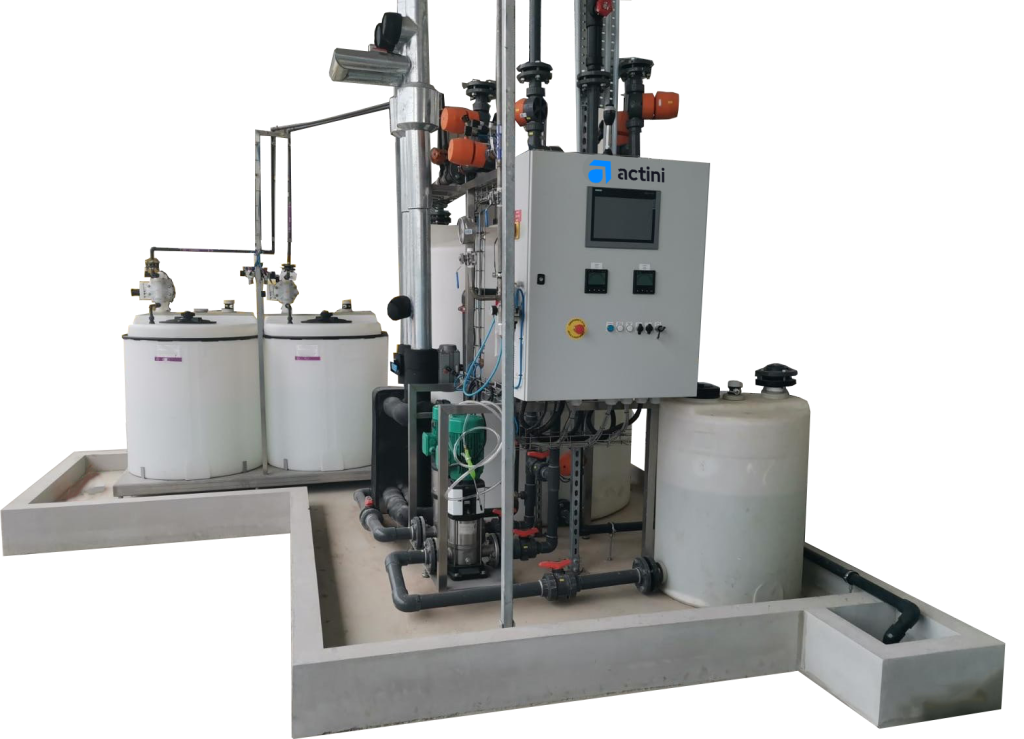
Continuous neutralization by Actini Group

What are the main components of a neutralization system?

An industrial neutralization system generally consists of several pieces of equipment working together to ensure reliable pH adjustment:

  • neutralization tank;
  • buffer or validation tank;
  • acid and caustic soda dosing pumps;
  • pH measurement probe;
  • recirculation and mixing system;
  • electrical control cabinet;
  • supervision and operation interface.

The exact configuration depends on the type of effluent, flow rate and site requirements.

Which parameters affect neutralization efficiency?

Several factors influence neutralization performance:

  • incoming effluent pH;
  • flow rate;
  • discharge variability;
  • effluent temperature;
  • contact time;
  • mixing efficiency;
  • reagent type.

Proper system sizing must take all these parameters into account to ensure reliable operation and long-term compliance.

Batch or continuous neutralization: which solution should you choose?

The choice mainly depends on the volume of wastewater to be treated and the operating mode of the facility.

Criteria

Batch Neutralization

Continuous Neutralization

Operation Batch treatment Continuous treatment
Flow rate Low to medium Medium to high
Flow profile Intermittent Continuous
pH control Per cycle Real-time
Applications Laboratories, small units Industrial production
Automation level High Very high

Batch neutralization is particularly suitable for intermittent volumes, while continuous neutralization is designed for facilities operating continuously.

Actini Group neutralization solutions adapted to every process

Whether dealing with batch-generated effluents or continuous flows, Actini Group neutralization systems provide effective pH control while ensuring safety, compliance and operational performance. Through a wide range of equipment and recognized expertise in critical processes, Actini supports manufacturers in designing and integrating solutions tailored to their specific requirements.

Batch neutralization (BNS)

The BNS system has been designed to adjust the pH of batch-treated effluents.

It provides:

  • automated neutralization;
  • precise pH control;
  • optimized contact time;
  • validation before discharge;
  • easy integration into existing installations.

Available capacities

From 1,000 to 16,000 liters per day.

Continuous neutralization (CNS)

The CNS system provides continuous pH regulation.

It is designed for:

  • continuous flows;
  • industrial facilities;
  • continuous decontamination systems;
  • applications requiring real-time control.

Available capacities

From 1,000 to 12,000 liters per hour depending on the model.

Why choose Actini Group?

Expertise in critical processes

For more than 70 years, Actini Group has been developing equipment for processes where biological, chemical and environmental risk control is essential.

Advanced automation

Our systems provide automatic pH control while minimizing operator intervention.

Complete integration

Neutralization systems can be integrated with Actini biological effluent decontamination systems.

Tailored solutions

Standardized or custom-designed configurations can be proposed according to site constraints and process requirements.

Industrial applications

Actini neutralization systems are used in:

  • pharmaceutical manufacturing;
  • biotechnology;
  • vaccine production;
  • cell and gene therapies;
  • BSL-2, BSL-3 and BSL-4 laboratories;
  • research centers;
  • bioproduction facilities;
  • chemical industries;
  • effluent decontamination units.

Have a question, requirement or project?

Talk to our experts about your industrial wastewater treatment challenges. Our teams support you throughout every stage of your project, from design and engineering to manufacturing and implementation.

FAQ – Effluent neutralization

What is an effluent neutralization system?

An effluent neutralization system automatically adjusts wastewater pH before discharge to ensure environmental compliance.

What is the difference between neutralization and decontamination?

Neutralization acts on pH, while decontamination aims to eliminate or inactivate biological agents or contaminants present in the effluent.

When should batch neutralization be used?

When effluents are generated in batches or intermittently.

What is the regulatory pH range for industrial discharge?

Acceptable pH values depend on local regulations and the discharge destination. In many cases, wastewater must be neutralized before being discharged to a sewer network or treatment facility.

What is the difference between acidic and alkaline effluents?

An acidic effluent has a pH below 7, while an alkaline effluent has a pH above 7. Both may require adjustment before discharge when outside authorized limits.

Are Actini neutralization systems customizable?

Yes. Systems can integrate various options depending on process constraints, treatment volumes, effluent temperature and operational requirements.

When should continuous neutralization be used?

When effluents are generated continuously and require permanent pH control.

Which effluents can be neutralized?

Chemical, pharmaceutical and biotechnological effluents, wash water, CIP discharges and wastewater from decontamination systems.

Why control pH before discharge?

To protect networks, equipment and the environment while complying with applicable regulations.

Which industries use neutralization systems?

Neutralization systems are used in pharmaceutical, biotechnology, chemical and food industries, as well as research laboratories and decontamination facilities.

What is the difference between automatic and manual neutralization systems?

An automatic system continuously measures pH and automatically adjusts reagent dosing. This improves treatment accuracy and reduces the risk of human error.

Which reagents are used for neutralization?

Depending on the wastewater characteristics, neutralization generally relies on the controlled injection of acid or caustic soda to bring pH back within the target range.

Show filters
Reinitialize filters
2 of 2