

Treatment program
• Adjustable time/temperature scale according to specifications
Model: Cyclobatch (BDS)
Capacity: from 100 up to 16,000 liters per day
Technology: Batch
Energy: Steam
Design: Standard and custom


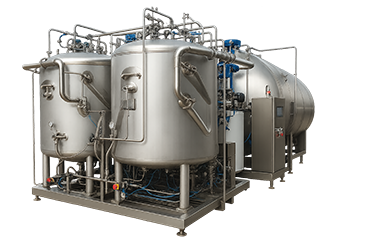
Resulting from our R&D efforts, the CYCLOBATCH decontamination system stands out for its exceptional thermal and energy performance, as well as its unique features, offering a treatment capacity ranging from 100 to 16,000 liters per day.
Particularly well-suited for effluents containing particles or with variable viscosity, the CYCLOBATCH provides optimal flexibility thanks to a wide range of possible configurations. Every BDS system can be customized to precisely meet your needs in terms of flow rate, effluent type, biosafety level, time/temperature requirements, and even redundancies—ensuring efficient and secure integration into your facilities.
MODELS |
USEFUL CAPACITY |
VOLUME BATCH |
AVERAGE DAILY CAPACITY* |
|---|---|---|---|
| BDS-30 | 30 liters | 60 liters | 100 to 1.000 liters |
| BDS-300 | 300 liters | 510 liters | 1.000 to 3.500 liters |
| BDS-750 | 750 liters | 1.250 liters | 3.500 to 7.500 liters |
| BDS-1600 | 1.600 liters | 2.500 liters | 7.500 to 12.000 liters |
| BDS-2200 | 2.200 liters | 3.500 liters | 12.000 to 16.000 liters |
*Average daily capacity: depending on process temperature/time/steam and cooling water available (based on 20-hour/day operation).
• Adjustable time/temperature scale according to specifications

• Steam • Energy recovery section

• Direct steam injection • Patented technology • Indirect heating technology also available
The system meets the most stringent containment requirements, up to BSL-3 and SIL 3 levels. It relies on a patented tangential steam injection technology that generates cyclonic agitation inside the treatment vessel. This process ensures faster and perfectly uniform heating, including at the core of the vessel.
The device can be configured with redundancy through the integration of two decontamination tanks, thus ensuring continuous operation. Treatment efficiency is continuously monitored by dedicated sensors.
Contaminated effluents are strictly contained by a set of safety devices, eliminating any risk of recontamination of the treated product, notably thanks to the pressurization of effluents that have not yet been decontaminated.

Reliability: no vent filters (eliminates the risk of clogging), no gaseous emissions
Gravity filling and draining to avoid using pumps that could cause leaks and to maximize containment
Energy recovery section enabling natural preheating and precooling of inlet and outlet effluents without adding refrigerant (80% savings on thermal energy used)
Pressure drainage during the heating cycle
Quiet operation: injection system equipped with SilentBlock technology (75 dBA vs. 100 dBA for equivalent systems)
External cooling of the decontamination tank: the tank remains hot, reducing energy consumption by nearly 25%
Fully automated: supervision controls every step (from contaminated liquid collection to decontaminated liquid discharge) for safe operation and complete traceability
Cycles managed by PLC and controlled via a touchscreen on the front of the electrical cabinet
Fully instrumented system (temperature sensor, flow meter, pressure and level transmitters, valves)
CIP (Clean-in-Place) system
Compact footprint
No foaming effect


